
Available Studies
Breneman CB, et al. Gulf War Illness: A Randomized Controlled Trial Combining Mindfulness Meditation and Auricular Acupuncture. Global Advances in Integrative Medicine and Health. 2023;12:1–12. doi:10.1177/27536130231171854. PMID:37151571. ClinicalTrials.gov: NCT02180243.
Binesh M, et al. Comparison of Mindfulness Intervention, Ear Acupuncture, and Their Combined Intervention on Eating Behaviour Styles and BMI in Women with Obesity. Iranian Journal of Health Education and Health Promotion. 2025. Accessed Oct 22 2025.
Liu Q, et al. Mindfulness-Based Stress Reduction with Acupressure for Sleep Disorders in Breast Cancer: Randomized Controlled Trial. Eur J Oncol Nurs. 2022. PMID:36257214.
Chung CY, et al. Effectiveness of Acupuncture and Mindfulness Meditation for Weight Management: Study Protocol for a Randomized Sham-Controlled Trial. Trials. 2022;23:780.
(Body Acupuncture)
Mosavi Z, et al. Effects of Auricular Acupressure on Test Anxiety in Medical Students: A Randomized Parallel-Group Trial. BMC Medical Education. 2023;23:
Psychological Outcome Measure: Emotional State Check-In/Out (ESCI-4)
Rationale and development
To capture short-term psychological changes associated with auricular acupuncture and mindfulness interventions, we developed the Emotional State Check-In/Out (ESCI-4)—a brief, emoji-based self-report measure designed for digital delivery. The ESCI-4 combines key constructs from three validated tools frequently used in mind–body and stress research:
Perceived Stress Scale (PSS-4) – measures perceived stress and coping over recent days (Cohen et al., 1983).
State–Trait Anxiety Inventory – State subscale (STAI-S) – assesses transient anxiety and tension (Spielberger et al., 1983).
Visual Analogue Scale (VAS) – captures momentary affect or perceived stress intensity (Gift, 1989).
The adaptation was created to provide a rapid, visually intuitive method suitable for repeated pre- and post-session use, reducing respondent burden while maintaining theoretical fidelity to established constructs.
Structure and scoring - Participants select one emoji per item (1 = most negative → 5 = most positive).
Domains include:
Perceived stress/tension
Anxiety/restlessness
Mood/affect
Body comfort/groundedness
Responses are stored numerically (1–5) and averaged by domain. Change scores (post–pre) are calculated for each session to indicate direction and magnitude of emotional shift.
Psychometric considerations
Although simplified, the ESCI-4 preserves the conceptual dimensions of the PSS-4 and STAI-S. Content validity was reviewed by a multidisciplinary panel of oncology nurses and psychologists. Pilot testing will assess:
Internal consistency (Cronbach’s α ≥ 0.70 target)
Test–retest reliability over one session
Convergent validity with standard PSS-4 and STAI-S in a subsample (n ≈ 20)
Citation statement for report
Emotional outcomes were assessed using the Emotional State Check-In/Out (ESCI-4), an emoji-based composite derived from the PSS-4 (Cohen et al., 1983), STAI-S (Spielberger et al., 1983), and Visual Analogue Scale (Gift 1989), developed by AuraQ Lab (2025) for rapid pre- and post-session assessment.”
Implementation
The questionnaire is delivered electronically (tablet or phone). Completion time ≈ 30 seconds per use. Data export in numeric form enables integration with physiological or qualitative measures.
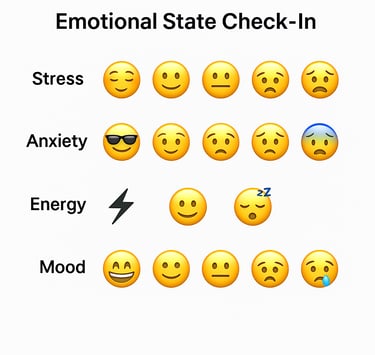
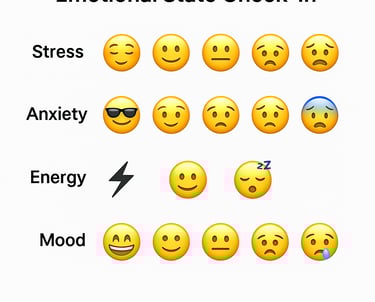
Pre-Session
Emotional Check-In
Instruction: “Tap the emoji that best shows how you feel right now.”
DomainEmojis (1–5 scale)Mapping:
Stress / Tension😌 😊 😐 😣 😫mirrors PSS high→low stress
Anxiety / Restlessness😎 🙂 😕 😟 😨maps to STAI-S
Energy / Fatigue⚡🙂 😴optional 3- or 5-emoji gradient
Mood😀 🙂 😐 😔 😢general effect
Body Sensation (comfort)🧘♀️ 🙂 😐 😖quick somatic read
Calm / Groundedness: 🌀🧘♀️🙂😐😣
Connection / Presence: 💫🙂😐😕😞
Repeat the same items + add optional text:
“Would you like to share any words about your experience?” (free box).
Post-Session
Emotional Check-Out
Back-End Mapping
Each emoji = numeric value (1–5).
Compute pre–post difference per domain.
Aggregate average change → quick dashboard for stress ↓, calm ↑, etc.
Psychologically valid proxy for PSS + STAI-S + mood VAS, usable in mobile/web form.
Advantages
Takes < 30 s to complete.
Culturally neutral icons (Unicode emojis work on phones/tablets).
Suitable for anonymous research capture.
Can export numeric data to CSV for analysis.